
Managing Blood Pressure Medication for a Parent From Another City
If you manage a parent’s blood pressure care from another city or abroad, you need visibility, refill planning, side effect checks, and one shared medicine list.
- ✓Start with one shared medicine list that includes names, strengths, doses, timing, and pharmacy details.
- ✓Use a simple BP log so you can spot patterns without overwhelming your parent.
- ✓Plan refills before the bottle is nearly empty, especially when you are not nearby.
- ✓Agree on red flags and who should be contacted when readings, symptoms, or side effects change.
Remote blood pressure care works better as a system, not a reminder chain
You cannot see the medicine bottle from another city. You cannot tell whether yesterday's dose was missed because your mum felt fine, or whether your dad took a second tablet because he forgot the first one.
That is the hard part of managing a parent's blood pressure medication from Lagos, Abuja, London, Toronto, Accra, or anywhere else. The problem is usually not love or effort. It is visibility.
Hypertension care needs a routine that still works when nobody is panicking. Medication has to be taken consistently. Blood pressure readings need to be checked correctly and written down. Refills need to start before the bottle is empty. Side effects need to be noticed early. If you need the wider care framework first, start with Famasi's guide to checking, tracking, and managing high blood pressure in Nigeria. When something changes, the doctor or pharmacist needs accurate information.
The answer is a small remote care system: one medicine list, one BP log, one refill rhythm, one reminder setup, one escalation plan, and one practical support route when the routine gets complicated.
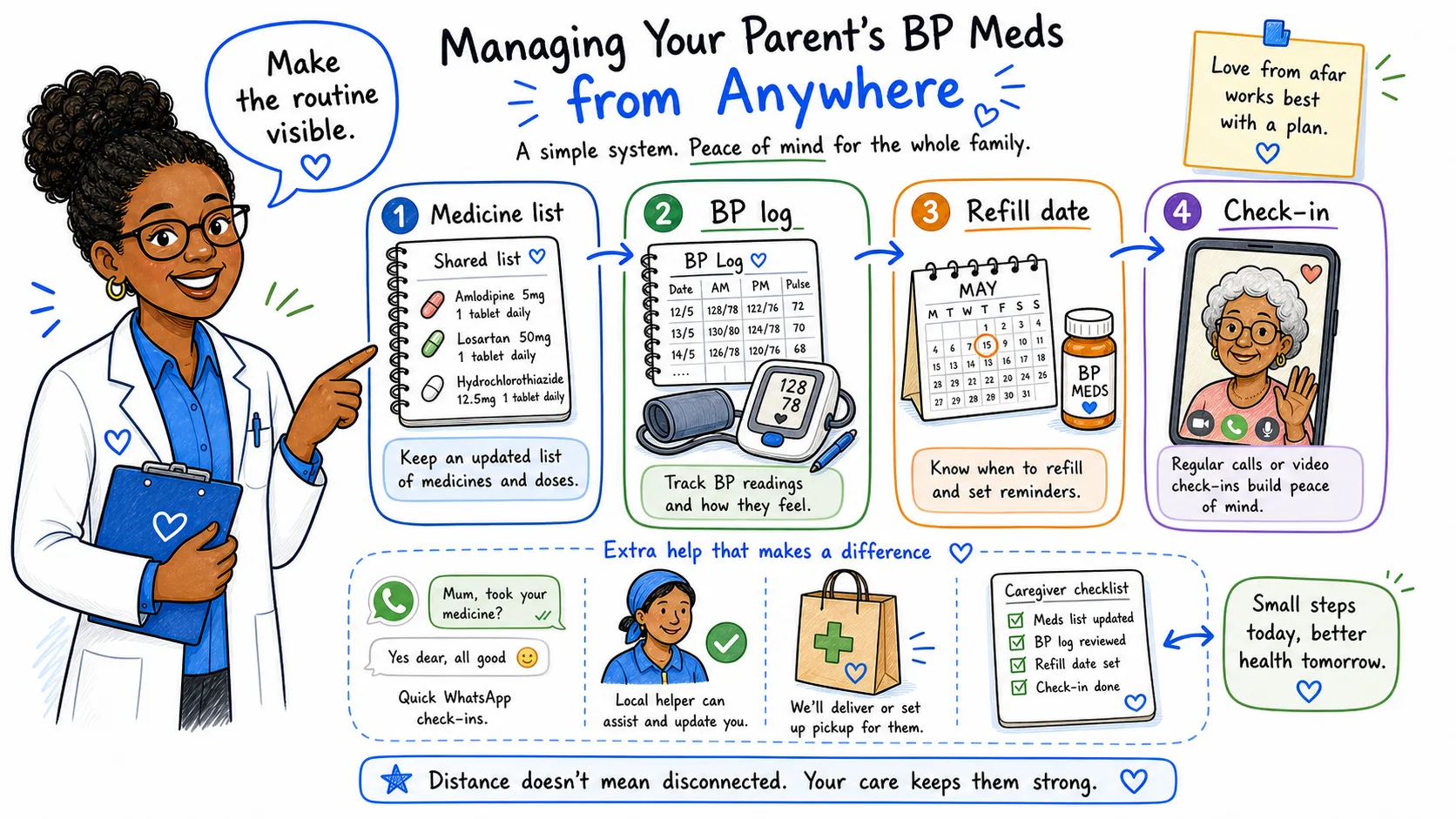
Build the remote care system around the facts you need to see
A remote care system should make the important things visible without turning every family call into a health audit. Start with the information that affects safety: what your parent takes, what their readings look like, when the next refill is due, and what should trigger help.
Create one shared medicine list
Start with one written list that your parent, you, and one trusted person nearby can access. It can be a Google Doc, Apple Note, pinned WhatsApp message, or printed paper on the fridge. The best format is the one your parent will actually use.
Include:
* Medication name: brand and generic name if possible * Strength: for example, amlodipine 5 mg or losartan 50 mg * Dose: how many tablets they take each time * Timing: morning, night, with food, without food, or as directed * Prescribing clinician: doctor or clinic name * Pharmacy used: where they usually buy or receive the medicine * Start date or last review date: when the medicine was started or last changed * Known side effects: ankle swelling, dizziness, cough, frequent urination, or anything your parent has reported * Allergies: any medicine they must not take
This list prevents guesswork. If your parent goes to a different pharmacy, the pharmacist needs the correct medicine and strength. If a neighbour helps with pickup, they need more than "buy my BP drug." If the doctor changes amlodipine from 5 mg to 10 mg, update the list the same day so the old dose does not keep circulating.
Keep the BP log simple enough to survive real life
A blood pressure log should answer one question: is the pattern stable, improving, or getting worse? It should not become a spreadsheet your parent quietly abandons.
Use this format:
* Date * Time * Reading: for example, 138/84 mmHg * Pulse: if the monitor shows it * Medication taken? yes/no * Notes: headache, poor sleep, missed dose, stress, travel, or checking after climbing stairs
Ask your parent's clinician how often they should check. Stable readings may not need daily checks forever. New medication, a dose change, or repeated high readings may need closer monitoring for a short period. If the numbers are already scattered across WhatsApp photos and notebook pages, use a simple blood pressure log your doctor can actually read.
The American Heart Association recommends home monitoring for people with high blood pressure because it helps health care professionals understand whether treatment is working. It also warns that home monitoring does not replace regular doctor visits, and normal home readings are not a reason to stop medication without medical advice.
If typing numbers is stressful, ask your parent to send a photo of the monitor once or twice a week. If the monitor stores readings, review the saved numbers during calls or clinic visits. When home readings seem inconsistent, first check whether your parent is using the right cuff position, rest time, and posture; Famasi has a separate guide on how to check blood pressure correctly at home.
Set a refill rhythm before the bottle is empty
The refill trigger should be 7 days before the medicine finishes, not the day the bottle becomes empty. By the time the bottle is empty, the system has already failed.
For remote caregiving, use a monthly rhythm:
* Day 1 of a new supply: record how many tablets arrived and when the first dose was taken * Day 21 to 23: ask your parent or local helper to count what is left * 7 days before finish: confirm prescription validity, refill, delivery, or pickup * 3 days before finish: check that the medicine is physically in the house * Refill day: update the medicine list with the new supply date
This buffer matters in Nigeria. The pharmacy may be out of stock. Delivery may be delayed. A public holiday may interrupt plans. Your parent may not mention the bottle is almost empty until the last minute. For the fuller monthly setup, use a refill routine for blood pressure medication instead of handling every refill as a fresh emergency.
If your parent takes more than one medicine, ask the pharmacist whether refill dates can be aligned. One monthly refill checkpoint is easier to manage than three scattered refill dates.
Build reminders around habits, not shame
The goal is not to call every day forever. The goal is to attach the medicine to something your parent already does.
That could be morning prayers, breakfast if the doctor says the medicine can be taken with food, brushing teeth at night, a daily radio programme, or a pill organiser refilled every Sunday.
Use phone alarms if your parent is comfortable with them. Label the alarm clearly: "Take BP medicine." If alarms get ignored, make the system more human: a local person checks the pill organiser twice a week, while you review the BP log weekly.
Be careful with shame. Many older adults do not want to feel monitored like children. Instead of "Have you taken your drug?" every day, try:
* "What time works best for your medicine now?" * "Should we move the reminder to after breakfast?" * "Can you send me a picture of the pill organiser on Sundays?"
A Nigerian study among hypertensive outpatients in Sokoto found very low optimal medication adherence, with forgetfulness as the most common reason for non-adherence. A Lagos study in elderly patients also found difficulty remembering medicines was the main reason among those who struggled. Treat forgetting as a system issue, not a character issue.
Decide what happens when readings, symptoms, or side effects change
Remote caregiving becomes dangerous when nobody knows what counts as urgent. Write escalation rules down before there is a crisis, and share them with your parent and local helper.
Use clear emergency rules
A very high blood pressure reading is usually considered higher than 180/120 mmHg. If your parent sees a reading around this level, they should sit quietly and recheck after a few minutes, unless serious symptoms are present.
Seek urgent medical care immediately if a very high reading comes with:
* Chest pain * Shortness of breath * Weakness or numbness, especially on one side * Trouble speaking * Sudden change in vision * Confusion * Severe headache that feels unusual * Severe back pain * Fainting or near-fainting
The American Heart Association and NHLBI both advise urgent emergency response when BP is above 180/120 mmHg with symptoms such as chest pain, breathing difficulty, weakness, vision change, or difficulty speaking.
Escalate patterns, side effects, and medication mistakes
Some situations are not emergencies, but they still need clinical input. Contact a clinician or qualified pharmacist if readings stay high across several days despite medication, your parent has repeated dizziness or falls, they stop medication because of blood pressure medication side effects, they accidentally take too many tablets, or a new medicine is added and you are unsure about interactions.
Do not adjust the dose yourself from abroad. Do not tell your parent to double up because the reading is high. Do not tell them to stop because the reading is normal; a normal BP reading while on medication usually needs a clinician's interpretation before anything changes. Dose changes need a clinician.
Your role is to notice, document, and connect your parent to the right care quickly.
Prepare clean information for appointments
Before a clinic visit, send or print the updated medicine list, the BP log for the last 2 to 4 weeks, missed doses, side effects, recent hospital visits, photos of medication packs, and the questions your parent may forget to ask. If you are not sure what belongs on that list, use these questions to ask the doctor about blood pressure as a starting point.
If you want to join by phone, ask your parent first. Some parents want help; others want privacy. Agree on what you are allowed to discuss.
Useful questions for the doctor or pharmacist include:
* "What BP range are we aiming for at home?" * "How often should they check BP?" * "What should we do if they miss one dose?" * "Which symptoms mean we should seek urgent care?" * "When is the next medication review?" * "Can we align refill dates for all medicines?" * "Are there medicines they should avoid with this prescription?"
The WHO highlights team-based care, patient tracking, recall systems, digital tools, and telemedicine as useful parts of long-term hypertension control. Remote caregivers need exactly that kind of structure.
Keep the weekly check-in short and let Famasi support the routine
Make the weekly call predictable. If every call becomes a full health audit, your parent may start avoiding it.
Use a five-point check-in:
- Medication: "Any missed doses this week?"
- Supply: "How many tablets are left?"
- BP readings: "What were the last two or three readings?"
- Symptoms: "Any dizziness, swelling, chest discomfort, breathlessness, headache, or unusual weakness?"
- Next action: refill, clinic appointment, pharmacist question, or no action
End with something normal: food, church, visitors, football, neighbours, grandchildren, or whatever your parent actually enjoys. They are not a project. They are your parent.
If your parent is in Nigeria and you manage their medication from somewhere else, Famasi can support the refill and pharmacist-support parts of the system.
Famasi Care Specialists are licensed pharmacists who support chronic medication routines. They do not diagnose, prescribe, or replace your parent's doctor. Their role is practical: medication questions, refill planning, timing, side effect guidance, and coordination when you need pharmacist input between clinic visits.
For a remote caregiver, that can mean setting up recurring refills, ordering medication through Famasi's Send feature, getting help when a blood pressure medicine is out of stock or the brand changes, asking a pharmacist what details to prepare before a doctor's appointment, and keeping the routine steady when you cannot physically check the bottle yourself.
Famasi works best when the basics are already in place: medicine list, refill rhythm, BP log, and escalation plan. It can support the system, but it should not be the only system.
Summary: What to Take Away From This Guide
* Managing a parent's BP medication remotely is mainly a visibility problem. * Start with one shared medicine list that includes name, strength, dose, timing, prescriber, pharmacy, side effects, and allergies. * Keep the BP log simple: date, time, reading, pulse, medication taken, and notes. * Use a 7-day refill rule so the refill starts before the bottle is empty. * Build reminders around your parent's existing routine instead of relying only on daily calls. * Write down urgent escalation signs, especially BP above 180/120 mmHg with symptoms such as chest pain, breathlessness, weakness, vision changes, or difficulty speaking. * Work with your parent's clinician and pharmacist using clean information, not guesses. * Famasi Care Specialists can support refill planning, pharmacist questions, and caregiver coordination for parents in Nigeria.
Common Questions About Managing a Parent’s BP Medication Remotely
How do I know if my parent is taking BP medication?
What should be on my parent’s medication list?
How often should I check in about BP medication?
What BP symptoms should make me act quickly from another city?
Can Famasi help me manage medication for a parent in Nigeria?
Just for you
References
- American Heart Association. Home Blood Pressure Monitoring.
- American Heart Association. Understanding Blood Pressure Readings.
- National Heart, Lung, and Blood Institute. High Blood Pressure Symptoms.
- World Health Organization. Global report on hypertension: The race against a silent killer.
- Michael GC, et al. Treatment adherence and blood pressure outcome among hypertensive out-patients in two tertiary hospitals in Sokoto, Northwestern Nigeria. BMC Cardiovascular Disorders. 2018;18:93.
- Ayonote UA, Akujuobi OM, Ogbonna AN. Medication Adherence and Perceived Family Support Among Elderly Patients with Hypertension Attending a Specialty Clinic in Lagos, Nigeria. Annals of Health Research. 2024.
- Ogedegbe GO, et al. Barriers and Enablers of Antihypertensive Adherence Among a Nigerian Adult Hypertensive Population Seeking Care in Public Secondary Health Facilities in Delta State, Nigeria. PubMed. 2025.
- Ogedegbe G, Schoenthaler A. A Systematic Review of the Effects of Home Blood Pressure Monitoring on Medication Adherence. Journal of Clinical Hypertension.