
How to Keep a Blood Pressure Log Your Doctor Can Actually Use
A useful blood pressure log helps your doctor see patterns, timing, missed doses, and symptoms. Here is what to record, how often to check, and how to interpret readings safely.
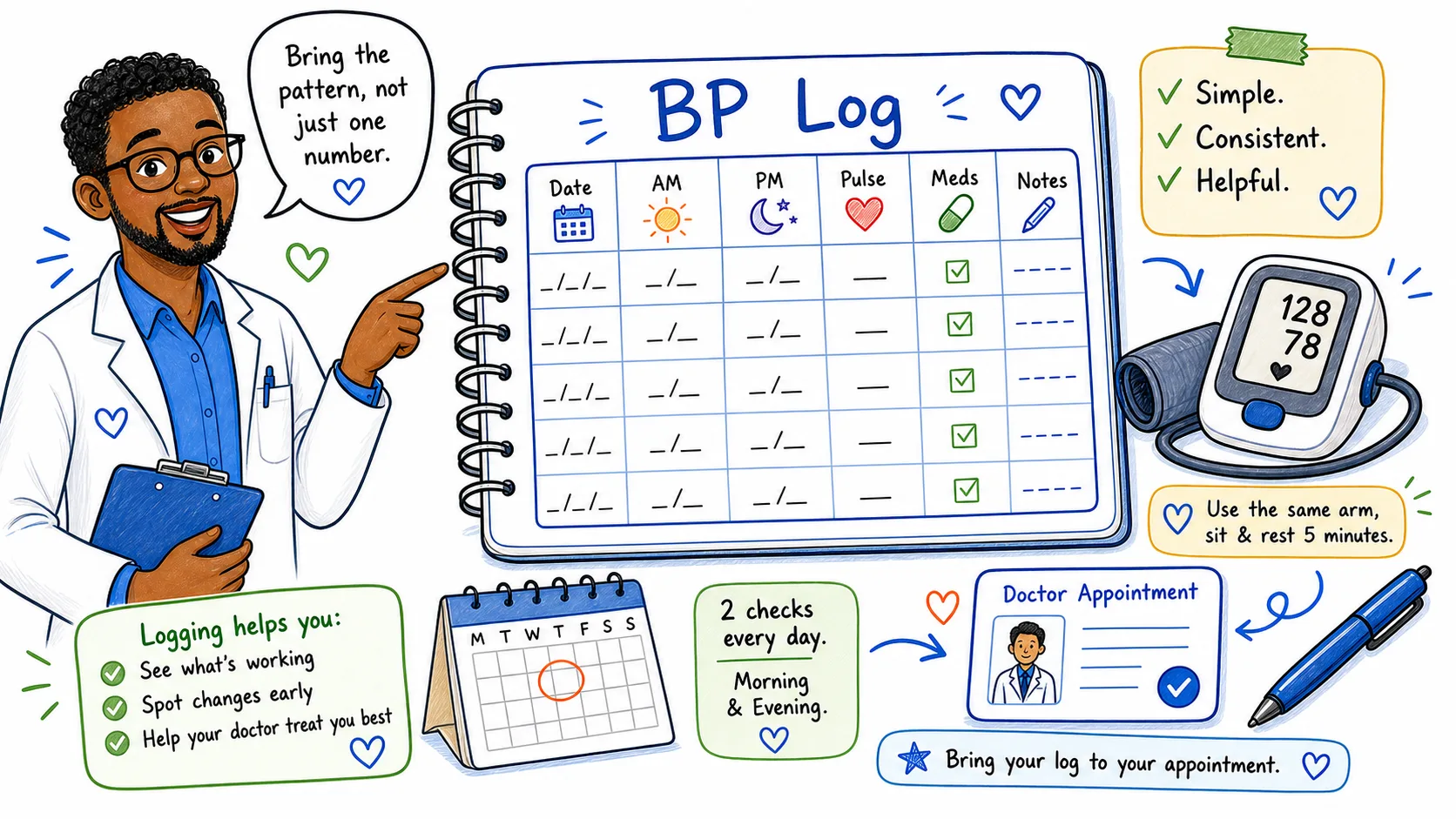
- ✓Record the date, time, two readings, average, pulse, arm used, medication timing, and short notes.
- ✓A pattern over several days is more useful than one isolated number.
- ✓Don't change medication based on a log without speaking with your clinician.
- ✓Bring the log to appointments so your doctor can interpret trends with context.
A good blood pressure log makes the appointment easier
One blood pressure reading tells your doctor what happened in one moment. But a log shows what keeps happening: morning numbers, evening numbers, medication timing, missed doses, symptoms, sleep, stress, and readings that don't fit the pattern.
That's the difference between saying, "My BP has been high," and showing your doctor 7 days of readings they can actually use. If you need the broader routine around checking, tracking, and medication, start with Famasi's guide to managing high blood pressure in Nigeria.
A useful log doesn't need to be beautiful. It needs to be honest, consistent, and easy to scan. Start with the template, then use the pattern to guide the conversation with your doctor or Care Specialist.
Copy this blood pressure log template
Use this in a notebook, phone note, spreadsheet, or printed page. If you're tracking for a parent or partner, put their name and medication details at the top so the log doesn't get mixed with someone else's readings.
Patient details
| Field | What to write |
|---|---|
| Name | Write the full name of the person being monitored. |
| Doctor or clinic | Add the clinic name or doctor you usually see. |
| BP monitor brand/model | Write the monitor brand, especially if you use it at home. |
| Usual BP medication and dose | Example: amlodipine 5mg every morning. |
| Target BP from doctor, if any | Write the target your doctor gave you, if they gave one. |
Daily blood pressure log
| Field | Morning | Evening |
|---|---|---|
| Date | Write today's date. | Write today's date. |
| Reading time | Example: 7:10am. | Example: 8:35pm. |
| Reading 1 | First reading, such as 146/91. | First reading, such as 136/84. |
| Reading 2 | Second reading, 1 minute later. | Second reading, 1 minute later. |
| Average | Average of the 2 readings, if you can calculate it. | Average of the 2 readings, if you can calculate it. |
| Pulse | Write the pulse shown on the monitor. | Write the pulse shown on the monitor. |
| Medication taken before reading? | Yes/No | Yes/No |
| Notes | Sleep, stress, caffeine, symptoms, missed dose, pain, exercise | Sleep, stress, caffeine, symptoms, missed dose, pain, exercise |
| Question for doctor or Care Specialist | Write the question you want to ask. | Write the question you want to ask. |
Here is one completed day:
| Field | Morning | Evening |
|---|---|---|
| Date | 12 May 2026 | 12 May 2026 |
| Reading time | 7:10am | 8:35pm |
| Reading 1 | 146/91 | 136/84 |
| Reading 2 | 141/88 | 134/83 |
| Average | 144/90 | 135/84 |
| Pulse | 78 | 74 |
| Medication taken before reading? | No | Yes, amlodipine 5mg at 7:30am |
| Notes | Slept late, no coffee, no symptoms | Normal day, walked 20 minutes, no symptoms |
| Question | Should I keep checking morning and evening or reduce to weekly? |
For a shorter message-style log, write it like this:
BP log - 12 May
| Time | Readings | Pulse | Medication | Notes |
|---|---|---|---|---|
| AM 7:10 | 146/91, 141/88 | 78 | Before meds | Slept late. No symptoms. |
| PM 8:35 | 136/84, 134/83 | 74 | Took amlodipine 5mg at 7:30am | No symptoms. |
That's enough for a doctor or Care Specialist to understand the day without scrolling through monitor photos.
Why the notes beside your BP reading matter
The reading is the headline, but the notes explain whether the number is useful, misleading, or urgent. Use the notes column to make the number easier to interpret.
| Detail in your log | Why it matters | Simple example |
|---|---|---|
| Date and time | Readings change across the day, so timing helps your doctor compare like with like. | 12 May, 7:10am |
| 2 readings, taken 1 minute apart | The first reading can be higher, so 2 readings give a better picture. | 146/91, then 141/88 |
| Average | The average is usually more useful than picking the highest or lowest number. | 144/90 |
| Pulse | Pulse can help your clinician understand symptoms like dizziness or palpitations. | Pulse 78 |
| Arm used | Switching arms can make readings harder to compare. | Left arm |
| Medication timing | Your doctor needs to know whether the reading was before or after medication. | Before meds, or amlodipine 5mg at 7am |
| Notes about the day | Context explains the number. | Slept 4 hours, missed morning dose, checked after walking, headache, no symptoms |
For Nigerian patients and caregivers, also record the practical things that often affect BP control: a refill delay, a brand switch, a borrowed tablet, a dose taken late, or a reading taken by a caregiver instead of the patient. If the issue is that your usual medicine is unavailable, use this guide on what to do when BP medication is out of stock before accepting a replacement.
Don't hide missed doses. Your clinician needs to know whether the medicine failed or the routine failed. Those are different problems.
How often should you check your blood pressure at home?
If your doctor wants to confirm a pattern, a common home monitoring plan is morning and evening readings for several days. The National Institute for Health and Care Excellence (NICE) recommends 2 consecutive measurements, at least 1 minute apart, twice daily, ideally for 7 days, when home monitoring is used to confirm hypertension. The first day's readings may be discarded when calculating the average for diagnosis.
The European Society of Hypertension gives a similar practical schedule: 7 days if possible, at least 3 days if 7 isn't possible, with morning and evening measurements and 2 readings each time.
A simple version:
- Morning: Before breakfast and before BP medication, unless your doctor told you otherwise.
- Evening: Before dinner or before sleep, at about the same time each day.
- Each session: Take 2 readings, 1 minute apart.
- Duration: Use 4 to 7 days before a clinic review, medication review, or new diagnosis discussion.
If your BP is already stable and your doctor hasn't asked for daily monitoring, you may not need to check every day. 1 or 2 planned checks per week may be enough because too much checking can make you anxious and can make the log harder to interpret.
How do you take the reading before writing it down?
A log filled with rushed readings can make your BP look worse than it is.
Before you check, avoid caffeine, smoking, alcohol, and exercise for 30 minutes. Empty your bladder. Sit quietly for at least 5 minutes. Keep your back supported, feet flat, legs uncrossed, and arm resting on a table at heart level. Put the cuff on bare skin and don't talk while the monitor is working.
Use the same arm each time once your clinician has advised which arm to use. If you're starting home monitoring for the first time, check both arms during an early session and tell your doctor if one arm is consistently more than 10-15 mmHg higher than the other.
If the first reading is unexpectedly high, don't panic and don't immediately check 5 more times. Sit quietly, wait 1-2 minutes, and take the second reading. Record both. If the 2 readings are very different, take a third and write a note.
Not sure whether the number is a true pattern or just one scary moment? Read what to do after one high blood pressure reading before changing anything.
How do you interpret your blood pressure log safely?
Your log should make the next conversation clearer. It shouldn't become a reason to change medication on your own.
If most readings are within your doctor's target
Keep your routine steady. Don't stop medication because the numbers look good. A normal reading while taking BP medication often means the treatment is working.
If readings are sometimes high with a clear trigger
Write down the trigger. Poor sleep, stress, pain, caffeine, smoking, missed medication, and checking too soon after activity can all affect readings. If the numbers settle when you measure correctly, that's useful information.
If readings are high over several days
Share the log with your doctor or Care Specialist. A common home blood pressure threshold used in several guidelines is 135/85 mmHg as the home-reading equivalent of clinic hypertension. That doesn't mean one reading above that level is a diagnosis. It means repeated home averages around or above that level deserve review.
Your clinician may check your technique, compare your monitor with a clinic device, review medication timing, discuss adherence, or request clinic or ambulatory monitoring.
If the log shows a clear time-of-day pattern, such as mornings being higher than evenings, use this guide on why BP readings change between morning and night to prepare the right context before your appointment.
If a reading is very high, or high with symptoms
If your BP is around 180/120 mmHg or higher, rest and recheck. If it stays very high, contact a clinician urgently.
If high readings come with chest pain, shortness of breath, weakness, numbness, confusion, severe headache, vision changes, difficulty speaking, or fainting, seek emergency care immediately.
Bring a short summary to your next appointment
If your log is long, don't make your doctor scroll through 200 phone screenshots. Bring the full log, but also prepare a short summary.
7-day BP summary
| Detail | Summary |
|---|---|
| Morning average | 142/88 |
| Evening average | 136/84 |
| Highest reading | 158/94 on Tuesday morning after poor sleep |
| Lowest reading | 118/74 on Saturday evening |
| Missed doses | None |
| Symptoms | Occasional dizziness when standing |
| Medication | Losartan 50mg every morning |
| Main question | Do we need to adjust the dose, or should I keep monitoring? |
Also bring your BP monitor if the clinic is willing to compare it with their device, a list of all medicines and supplements you take, and any questions you want answered.
For the appointment itself, it helps to prepare specific questions to ask your doctor about high BP readings, including your target range, medication timing, side effects, and when to seek urgent care.
Famasi Care Specialists can help you turn scattered readings into a clean summary, especially if several family members are helping to track medication for a parent or loved one. They don't diagnose hypertension or prescribe medication, but they can help organise the routine around your doctor's plan.
Summary: What to Take Away From This Guide
- Start with a simple log you can actually maintain.
- Record 2 readings in the morning and evening, plus pulse, medication timing, and short notes that explain the day.
- Look at averages and repeated patterns, not one number you liked or one number that scared you.
- Don't change, stop, or increase blood pressure medication because of a home log without speaking with your doctor.
- If a reading is very high or comes with warning symptoms, treat it as urgent and get medical help.
Common Questions About Blood Pressure Logs
How many days of BP readings should I bring to my doctor?
Should I record every blood pressure reading?
What should I write beside each BP reading?
Should I average my blood pressure readings?
Can a BP log tell me to change my medication?
References
- American Heart Association. Home Blood Pressure Monitoring.
- American Heart Association. My Blood Pressure Log.
- Centers for Disease Control and Prevention. Measuring Your Blood Pressure.
- Centers for Disease Control and Prevention. My Blood Pressure Log.
- National Institute for Health and Care Excellence. Hypertension in adults: diagnosis and management — recommendations.
- Stergiou GS, et al. 2021 European Society of Hypertension practice guidelines for office and out-of-office blood pressure measurement. Journal of Hypertension.
- Parati G, et al. Home blood pressure monitoring: methodology, clinical relevance and practical application — 2021 ESH position paper.
- Unger T, et al. 2020 International Society of Hypertension Global Hypertension Practice Guidelines. Hypertension.