
What to Do When Your BP Medication Is Out of Stock
When blood pressure medication is out of stock, do not skip, split, borrow, or swap casually. Here is how to confirm the medicine, ask about safe alternatives, and avoid dangerous gaps.
- ✓Confirm the exact medicine, strength, dose, and whether only the brand is out of stock.
- ✓A brand change may be acceptable, but a medicine or dose change needs clinician or pharmacist guidance.
- ✓Don't borrow someone else's BP medicine or split tablets unless a pharmacist confirms it is safe.
- ✓Keep checking your readings and record missed doses, substitutions, and symptoms.
Treat a stock-out as a medication-safety problem
When your blood pressure medicine is out of stock, the safest first move is not to skip, split, borrow, or swap. It is to confirm exactly what is missing and who can approve the next option.
The danger is that a small delay rarely feels urgent at first. The pharmacy says the medicine is unavailable today. Tomorrow becomes the weekend, a public holiday, a busy workday, or a delivery delay. By the time you find it, you may have missed several doses.
High blood pressure often gives no warning. You can feel completely fine while your blood pressure is rising again. The American Heart Association advises people not to stop prescribed blood pressure medicines without speaking with a health care professional, even when they feel well or their readings look better on medication.
This guide is not the same as building a monthly refill routine, or the wider system for checking, tracking, and managing high blood pressure. A refill routine helps you avoid the gap. This article is for the day the gap is already possible and you need to make the next decision without guessing at the pharmacy counter.
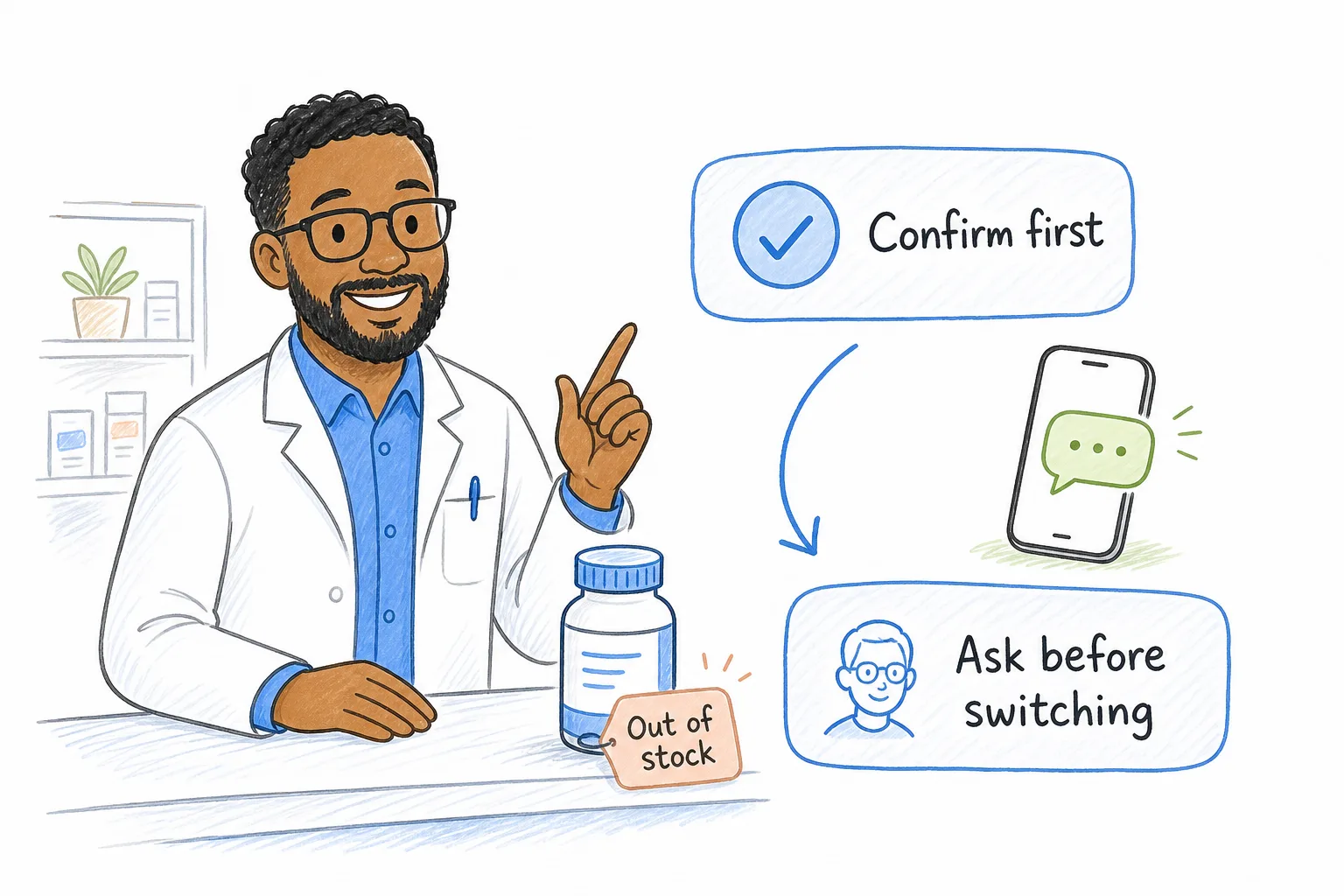
Use this decision tree before accepting a replacement
The question is not "Which BP drug can I buy?" The question is "What is the closest safe option for my exact prescription, and who has confirmed it?"
Step 1: Confirm the prescription
Check the medicine name, strength, dose, timing, and whether it is a single medicine or a combination tablet.
Look beyond the brand name. The active ingredient may be amlodipine, losartan, valsartan, lisinopril, hydrochlorothiazide, indapamide, or another medicine. If you have the pack, prescription, or blister sheet, show it to the pharmacist.
Step 2: Ask what is actually out of stock
Sometimes only your usual brand is unavailable. Sometimes the active ingredient, strength, dosage form, or combination pack is unavailable.
Those are different problems. A brand change may be simple. A change in active ingredient, strength, or formulation is a medicine change.
Step 3: If the same active ingredient and strength are available
Ask the pharmacist to confirm that the replacement has the same active ingredient, same strength, same dosage form, and same instructions.
If those details match and the product is registered and appropriate, a different brand or generic may be acceptable. You can also check the NAFDAC Greenbook, Nigeria's registered product database, but that does not replace pharmacist advice.
Step 4: If only a different medicine, strength, or formulation is available
Pause before buying it. Amlodipine is not nifedipine. Losartan is not telmisartan. Plain losartan is not losartan/HCTZ. A long-acting tablet is not always the same as a short-acting version with a similar name.
Ask the pharmacist to contact your prescriber, or contact your doctor yourself. If you cannot reach them, ask the pharmacist what temporary options are safe and what symptoms or readings should make you escalate urgently.
Step 5: If you have only a few tablets left
Count the tablets. Write down how many days you have at your usual dose. Do not quietly take one tablet every other day or cut the dose in half to make it last unless a doctor or pharmacist tells you to.
Call your regular pharmacy first, then ask whether another branch or trusted pharmacy has the exact medicine. If you take more than one BP medicine, do not stop all of them because one is missing. Ask what to do about the missing medicine specifically.
Seek urgent care if you develop chest pain, shortness of breath, sudden weakness, trouble speaking, confusion, severe headache, fainting, or vision changes. If your BP is around 180/120 mmHg or higher, rest and recheck it correctly if you have no symptoms. If it remains very high or you have symptoms, escalate urgently.
Use this pharmacist script at the counter or on WhatsApp
Stock problems are easier to handle when the pharmacist has the right details immediately. You can copy and adapt this message:
Hello. My blood pressure medicine is out of stock. I usually take [brand/generic name], [strength], [dose], [time of day]. Is only this brand unavailable, or is the active ingredient unavailable too? If you have an alternative, please confirm the active ingredient, strength, tablet type, whether it is plain or a combination tablet, and whether the dosing is exactly the same. If it is a different active ingredient, strength, or formulation, please let me know so I can contact my doctor before changing.
If the medicine is for a parent or partner, add:
I am helping someone else with this refill. I can send photos of the prescription, old pack, and blister sheet. Please confirm the replacement in writing before we buy it.
Ask these follow-up questions before paying:
* What is the active ingredient? * Is it the same active ingredient as the prescription? * Is it the same strength? * Is this a plain medicine or a combination tablet? * Is it immediate-release, extended-release, sustained-release, or long-acting? * Is it taken at the same time and frequency? * Is it registered for use in Nigeria? * Should the doctor approve this before the patient starts it?
That may feel like a lot, but it protects you from common mistakes: taking the wrong strength, taking a combination tablet without realising it contains a diuretic, duplicating the same medicine under two brands, or switching to a tablet that releases medicine differently.
What not to do while you are trying to find supply
Blood pressure medicines are not interchangeable just because they are all "BP drugs." They work differently, wear off differently, and carry different risks when stopped or combined.
Do not borrow someone else's BP medicine. Your neighbour's amlodipine 10 mg is not the same as your amlodipine 5 mg. Your uncle's losartan/HCTZ is not plain losartan. Your mother's nifedipine may be a different formulation from the nifedipine someone offers you.
Do not split tablets unless a pharmacist confirms your specific pack can be split. Some tablets are modified-release, and cutting them can change how the medicine enters your body. Combination tablets also make splitting more complicated because one pill may contain two or three medicines.
Do not stop beta-blockers or clonidine suddenly unless a clinician is managing the change. Beta-blockers such as atenolol, bisoprolol, metoprolol, carvedilol, and propranolol can cause problems when stopped abruptly. Clonidine can cause rebound hypertension, where blood pressure rises sharply. If symptoms start after a replacement or restart, handle them as blood pressure medication side effects, not as a reason to guess at another swap.
Do not take extra tablets randomly if your reading is high during the gap. Record the reading, recheck correctly, and use the same decision logic you would use for one high blood pressure reading.
Build a small backup system after the immediate problem is handled
Once you have a safe supply again, use the episode to strengthen your backup plan. The point is not to create a perfect spreadsheet. It is to make the next stock problem less chaotic.
Keep one accurate medicine list
Your list should include brand name, active ingredient, strength, dose, timing, tablet type, prescriber, usual pharmacy, allergies, medicines to avoid, and date of last review.
Keep photos of the prescription, pack front and back, and blister sheet. This helps when a relative is buying the refill, when you are messaging a pharmacist, or when you need to check whether a replacement is truly equivalent.
Set a refill buffer without repeating the whole refill routine
For ongoing prevention, use the fuller monthly refill routine for blood pressure medication. For stock-out recovery, focus on one buffer rule: start looking when you have 7 to 10 days left, and use 14 days if delays are common.
The medicine should be physically with you before you reach the last few tablets. A reminder is useful only if it leads to the pack being in the house.
Give caregivers the exact information
If you support someone from another city or country, do not rely on "Mummy's BP drug" or a brand name remembered from last month.
Keep a shared medicine list, choose one local backup person, and agree who can approve a brand equivalent. If a pharmacy offers a replacement, ask for a photo of the pack and blister sheet before anyone pays.
Remote caregiving breaks down when the person standing at the pharmacy has to guess while everyone else is unreachable. Write down who to call, what can be approved, and when the doctor needs to be involved.
How Famasi can help with the practical work
Famasi Care Specialists are licensed pharmacists who can support medication routines in Nigeria. They do not diagnose, prescribe, or replace your doctor, but they can help with the medication-safety work that sits between clinic visits.
They can help you confirm medicine details before a refill, organise recurring refills, support medication orders through Famasi's Send feature, and understand whether a suggested option looks like a brand/generic equivalent or a different medicine that needs clinician input.
They can also help caregivers keep track of refill timing and prepare the right information before calling a doctor: pack photos, prescription details, current BP readings, missed doses, side effects, allergies, and other medicines.
If your BP medicine is repeatedly hard to find, ask your doctor whether there is a clinically appropriate option that is easier to maintain consistently. Finding today's pack matters, but the bigger goal is keeping treatment continuous next month too.
Summary: What to Take Away From This Guide
* Treat an out-of-stock BP medicine as a medication-safety problem, not a casual shopping problem. * Do not stop, split, borrow, or swap blood pressure medicine without pharmacist or clinician guidance. * A different brand may be acceptable if the active ingredient, strength, form, and directions are the same. * A different active ingredient, strength, formulation, or combination tablet needs pharmacist or doctor input. * Use a clear pharmacist script so the replacement is confirmed before you buy it. * Keep a medicine list with brand name, active ingredient, strength, dose, timing, pack photos, allergies, and prescriber details. * Start looking for refills when you have 7 to 10 days left, or earlier if stock delays are common. * Seek urgent care for severe symptoms or very high readings with symptoms. Do not take extra doses randomly.
Common Questions About Out-of-Stock BP Medication
What should I do first if my BP medicine is out of stock?
Can I switch to another blood pressure medicine?
Can I borrow someone else’s BP medication?
What if I can only find a partial refill?
How can I prevent the next stock problem?
Just for you
References
- American Heart Association. Managing High Blood Pressure Medications.
- American Heart Association. Medication Management.
- World Health Organization. Guideline for the pharmacological treatment of hypertension in adults.
- NCBI Bookshelf / WHO. Executive summary: Guideline for the pharmacological treatment of hypertension in adults.
- NICE. Hypertension in adults: diagnosis and management (NG136).
- NCBI Bookshelf / NICE. Hypertension in adults: diagnosis and management.
- NAFDAC. NAFDAC Greenbook: Nigeria's Registered Product Database.
- National Heart, Lung, and Blood Institute. High Blood Pressure.