
Why Your BP Reading Changes Between Morning and Night
Blood pressure naturally changes through the day. Learn why morning and evening readings differ, when the pattern matters, and how to record readings your doctor can use.
- ✓Blood pressure normally rises and falls with sleep, activity, stress, food, medication timing, and illness.
- ✓One morning or evening reading is less useful than a repeated pattern measured correctly.
- ✓Record whether readings happened before or after medication.
- ✓Seek urgent care if high readings come with chest pain, weakness, severe headache, breathlessness, or confusion.
Morning and evening readings are useful because they show a pattern
Blood pressure is not meant to stay at one fixed number all day. It changes with sleep, waking, movement, stress, pain, food, caffeine, medication timing, and illness.
So a morning reading of 146/90 and an evening reading of 132/82 does not automatically mean something terrible is happening. It means you have two pieces of information. The next question is whether the same pattern repeats when you measure correctly.
That is what your doctor, pharmacist, or Care Specialist needs to see: not one number, but the relationship between time of day, medication, symptoms, and repeated readings.
If you want the full routine around checking, tracking, refills, and follow-up, read Famasi's guide to managing high blood pressure in Nigeria.
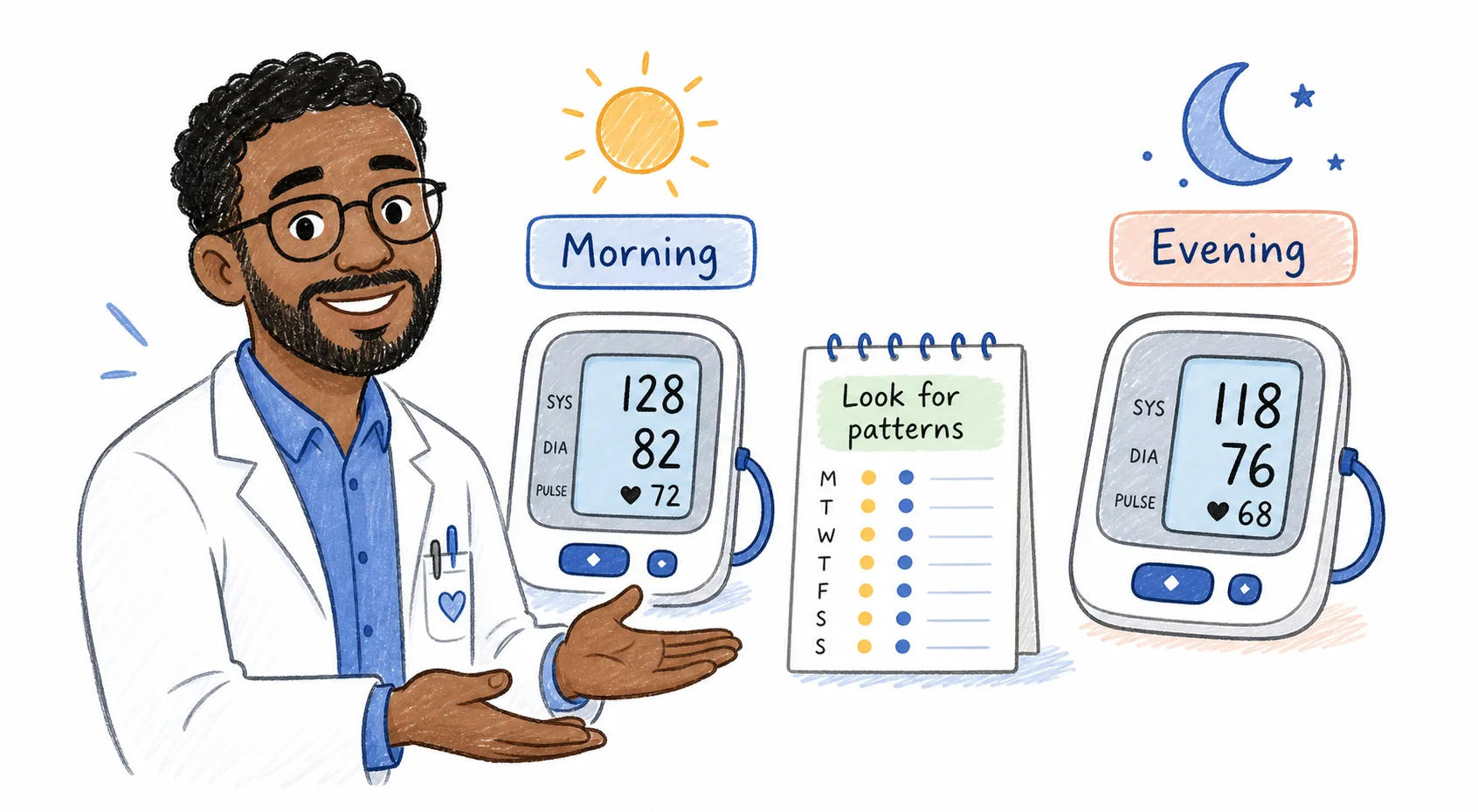
Read the pattern before you react to the number
Start by comparing like with like. A Monday morning reading before medication should not be treated the same as a Tuesday evening reading after food, traffic, stress, and a late dose.
Compare morning to morning and evening to evening over several days. Then look for one of four patterns.
Pattern 1: morning readings are repeatedly higher
Some rise in blood pressure around waking is expected. Your body is moving from sleep to activity, and the systems that control heart rate and blood vessel tone become more active.
Morning readings can also look high because of poor sleep, pain, anxiety, needing to urinate, checking before medication, or measuring before you have rested properly.
If the morning readings are high for several days, write down whether each reading was before or after medication and whether sleep was poor. Do not change your medication timing on your own. Your clinician may need to review the dose, timing, technique, or whether another monitoring method is needed.
Example:
``text 14 May: Morning 148/91 and 144/88 before medication after poor sleep. Evening 134/83 and 132/82 after a normal day. ``
That pattern points the conversation toward morning control, sleep, medication timing, and measurement technique.
Pattern 2: evening readings are repeatedly higher
Evening BP can rise because the day has happened. Work stress, caregiving, market runs, commuting, heat, physical work, salty meals, alcohol, caffeine, pain, and missed or late doses can all show up in the evening number.
Evening readings can also suggest that BP control may be wearing off before the next dose, but that is a medication review question for your clinician. Some BP medicines are taken in the morning, some at night, and some more than once daily.
Example:
``text 15 May: Morning 132/84 and 130/82. Evening 151/92 and 148/90 after late medication, traffic, and mild headache. ``
That pattern points the conversation toward evening stress, late dosing, and whether the routine is holding through the day.
Pattern 3: both morning and evening readings are high
If both morning and evening readings are repeatedly high, the issue may be overall BP control rather than time of day.
Many guidelines use 135/85 mmHg as a common home BP threshold that may suggest hypertension when it is the average pattern, not a single reading. If your home averages are repeatedly around or above that level, share the log with your doctor or pharmacist.
Your clinician may check your measurement technique, compare your home monitor with a clinic device, review medication adherence, look for refill gaps, or request ambulatory blood pressure monitoring.
Pattern 4: readings are random or scattered
Scattered readings often mean the measurement routine is inconsistent. One reading is after climbing stairs, one is after coffee, one is before medication, one is after medication, and one is taken while anxious because the first number looked high.
Before assuming the BP itself is unpredictable, clean up the routine for seven days. Sit quietly first. Use the same arm. Take two readings one minute apart. Record medication timing. Do not keep checking until you see a number you like.
If the readings remain scattered even with a consistent routine, bring the log to a clinician. The pattern may still be useful, but it needs medical interpretation.
For the measurement routine itself, use the step-by-step guide on how to check blood pressure correctly at home so the pattern is not being distorted by posture, timing, or cuff placement.
Use a 7-day plan to make the pattern clear
For the next seven days, unless your doctor gave you a different plan, use one routine and keep it boring.
Morning reading
Use the toilet if you need to. Sit quietly for at least five minutes. Check before breakfast and before BP medication, unless your doctor told you otherwise. Keep your back supported, feet flat on the floor, and arm resting at heart level.
Take two readings one minute apart. Record both readings, pulse, medication timing, and a short note.
Evening reading
Choose a time you can repeat, such as before dinner or before sleep. Avoid checking immediately after exercise, bathing, smoking, alcohol, caffeine, or a stressful activity.
Sit quietly for at least five minutes. Use the same arm and monitor. Take two readings one minute apart. Record anything that may explain the number: late dose, missed dose, pain, alcohol, poor sleep, traffic, stress, or symptoms.
What to do with the seven days
At the end, write a short summary:
``text 7-day pattern Morning average: Evening average: Highest reading and context: Lowest reading and context: Medication missed or late: Symptoms: Main question for doctor/pharmacist: ``
You can also use a fuller blood pressure log template if you need to record pulse, symptoms, medication timing, missed doses, and questions for your doctor in one place.
If the pattern worries you, share it with your doctor, pharmacist, or Famasi Care Specialist. Before that conversation, prepare the key questions to ask your doctor about high BP readings so you leave with a clear target, monitoring plan, and next step. Famasi can help organise the readings and refill routine, especially when a caregiver is tracking BP for a parent or loved one. Famasi does not diagnose hypertension or replace your doctor.
Know when the pattern needs medical attention
Morning and evening variation is normal. Repeated high readings, readings that are rising, or readings with symptoms deserve attention.
Call your doctor or speak with a clinician if your morning or evening readings are repeatedly high for several days, your readings are rising compared with your usual pattern, you recently missed doses or ran out of medication, or your home and clinic readings are very different.
If high readings started around dizziness, swelling, cough, frequent urination, or another new medicine concern, review what to do about blood pressure medication side effects and speak with a clinician before stopping or changing your dose.
This matters especially if you are pregnant or recently gave birth, or if you live with kidney disease, diabetes, previous stroke, or heart disease.
Seek urgent medical attention if your BP is around 180/120 mmHg or higher and remains high after resting and rechecking, especially if you have symptoms.
Do not wait at home if high readings come with chest pain, shortness of breath, weakness or numbness on one side, confusion, fainting, severe headache, vision changes, difficulty speaking, or severe dizziness.
Why clinic and home readings may not match
Sometimes the clinic reading is high and home readings are mostly fine. Sometimes the clinic reading looks fine and home readings are repeatedly high.
White coat hypertension means blood pressure is higher in the clinic or hospital than outside the clinic. Anxiety, rushing, waiting, pain, or stress can all affect a clinic reading.
Masked hypertension is the opposite. The clinic reading looks normal, but home or ambulatory readings are high. There is also masked uncontrolled hypertension, where a person already on BP treatment seems controlled in the clinic but has high readings at home or during daily life.
The European Society of Hypertension notes that white coat and masked hypertension are common in both untreated people and people already receiving treatment, with some groups showing rates around 15% to 25%.
If clinic and home readings do not match, do not assume one is fake. They may be measuring different situations. Your job is to record carefully. Your clinician's job is to interpret the pattern safely.
Summary: What to Take Away From This Guide
A higher morning or evening reading is not automatically a crisis. It becomes more useful when you know which pattern you are seeing: morning high, evening high, both high, or scattered.
Use a consistent 7-day routine before drawing conclusions. Take two readings in the morning and evening, record medication timing, and write short notes that explain the day.
Do not change medication because one time of day looks high. Share the pattern with your clinician.
If readings are very high or come with warning symptoms, treat that as urgent and seek medical care.
Common Questions About Morning and Evening BP Readings
Is blood pressure usually higher in the morning?
Why is my blood pressure higher at night?
Should I change when I take BP medication because morning readings are high?
How do I compare morning and evening BP readings?
When is a BP pattern urgent?
References
- American Heart Association. Home Blood Pressure Monitoring.
- American Heart Association. Understanding Blood Pressure Readings.
- Centers for Disease Control and Prevention. Measuring Your Blood Pressure.
- National Institute for Health and Care Excellence. Hypertension in adults: diagnosis and management — recommendations.
- Stergiou GS, et al. 2021 European Society of Hypertension practice guidelines for office and out-of-office blood pressure measurement. Journal of Hypertension.
- Parati G, et al. Home blood pressure monitoring: methodology, clinical relevance and practical application — 2021 European Society of Hypertension position paper.
- Shimbo D, et al. Self-Measured Blood Pressure Monitoring at Home: A Joint Policy Statement from the American Heart Association and American Medical Association. Circulation.
- Muntner P, et al. Measurement of Blood Pressure in Humans: A Scientific Statement From the American Heart Association. Hypertension.