- ✓"A cool bath helps, but it does not replace the water you lose through sweat."
- ✓"Set a phone alarm for night-time doses even if you sleep in another room."
- ✓"Take your mosquito net wherever you sleep, including outside."
- ✓"Cool, loose clothing and light bedding help heat rash; see a doctor if it is not better in a few days."
- ✓"Start ORS for diarrhoea and get a malaria test before treating a fever. Heatstroke is an emergency."
Bathing four or five times a day can take the edge off this heat, but it cools your skin only for a while and does not replace the water you sweat out. Moving outside when the room gets unbearable may help you sleep, but if the AC was keeping mosquitoes away, they can follow you out. Set times to drink through the day, and take your mosquito net if you move outside to sleep. You’ll also find ways to make the room cooler and what to do first for heat rash, diarrhoea or fever. For tablets or insulin affected by a power cut, read the main guide to medication storage and power cuts.
Bathing five times a day? You still need to drink
A cool bath helps you cool down, but it doesn't replace the water you lose through sweat. Keep drinking through the day, even when you're bathing often.
Why bathing isn't enough
Many people are bathing four or five times a day and still can't cool down. A cool bath or shower does help you cool down, and the NHS recommends it in hot weather. It doesn't replace the water you lose through sweat, though, and you can sweat a lot on a night with no fan.
How much to drink on very hot days
Drink water through the day, even when you don't feel thirsty, and keep some by your bed at night. The NHS also suggests going easy on alcohol, caffeine and hot drinks while it's this hot.
If you take water tablets, or you've been told to limit how much you drink because of a heart or kidney condition, ask a pharmacist or your doctor how much to drink on very hot days.
Hot nights with no light: sleeping and your night-time doses
Keep water by the bed and set a phone alarm for your usual dose time, even if you move to the parlour, the floor or outside to sleep. Leave the pack in its cool cupboard, not in a pocket or under your pillow.
Keep the room as cool as you can, keep water by the bed and take night-time doses at your usual time, even if you sleep somewhere else.
Keeping cool when there's no fan
The nights are the worst part. People are waking up with their bedsheets soaked through, and some have given up on the bed and are sleeping on the floor.
NHS heatwave advice has a few things that help when there's no fan. Keep windows and curtains shut in the hottest part of the day and open them at night once it's cooler outside. Use light bedding, and put cool water on your skin or clothes. If you have a rechargeable fan, it helps most while the room is below about 35°C. Keep water by the bed.
Your night-time doses
If you take a medication at night, the heat can knock your routine off. When you move to the parlour, the floor or outside to sleep, set a phone alarm for your usual time. Leave the pack in its cool cupboard rather than in a pocket or under your pillow, where it gets warm.
Check where your parents and children sleep
Older parents and young children struggle more in the heat, so check the room where they sleep too (NHS).
Sleeping outside or without the AC? Watch for mosquitoes
Take your mosquito net wherever you sleep, including outside, and use repellent after dusk. If anyone gets a fever, get a malaria test before taking malaria medication.
Take your mosquito net wherever you sleep, including outside, and use repellent after dusk.
Why the mosquitoes come when the light goes
When the light goes, the mosquitoes come. The AC that kept them out of the room goes off, and plenty of people end up moving outside at 2 or 3am to escape the heat.
How to protect yourself
Malaria spreads through the bites of infected mosquitoes. WHO advises sleeping under a mosquito net, using repellent after dusk, and using coils or window screens. If the heat drives you outside, take the net with you.
If someone gets a fever
Young children and pregnant women are more likely to get very ill from malaria (WHO). If anyone gets a fever, get a malaria test before taking malaria medication. The fever section below explains why.
Heat rash: what helps and when to get it checked
Keep your skin cool with loose cotton clothes, light bedding and cool baths. A pharmacist can suggest calamine lotion or another treatment. See a doctor if it is not better after a few days, or if your baby has a rash and you are worried.
Heat rash is usually harmless. Keep your skin cool so you sweat less, and get it checked if it isn't better after a few days.
What heat rash looks like
Many people are sweating through the day with heat rash on their neck. It happens when sweat gets trapped under the skin. It's uncomfortable but usually harmless, and it often clears up on its own within a few days (NHS). On brown or black skin, the spots may look grey or white rather than red.
What helps
The main thing is to keep your skin cool so you sweat less: loose cotton clothes, light bedding and cool baths. To calm the itch, hold a damp cloth or an ice pack wrapped in a cloth on it for up to 20 minutes, pat it instead of scratching, and skip perfumed creams and shower gels (NHS).
What a pharmacist can suggest
A pharmacist can suggest something for it, such as calamine lotion or an antihistamine. If you're offered an antihistamine, ask whether it's one of the older kinds that reduce sweating (see older allergy and sleep tablets). Hydrocortisone cream isn't for children under 10 without a doctor's advice (NHS). Ask a pharmacist before you put any powder or cream on a baby.
When to get it checked
See a doctor if the rash isn't better after a few days, or if your baby has a rash and you're worried (NHS).
ORS, fever and overheating: what to do first
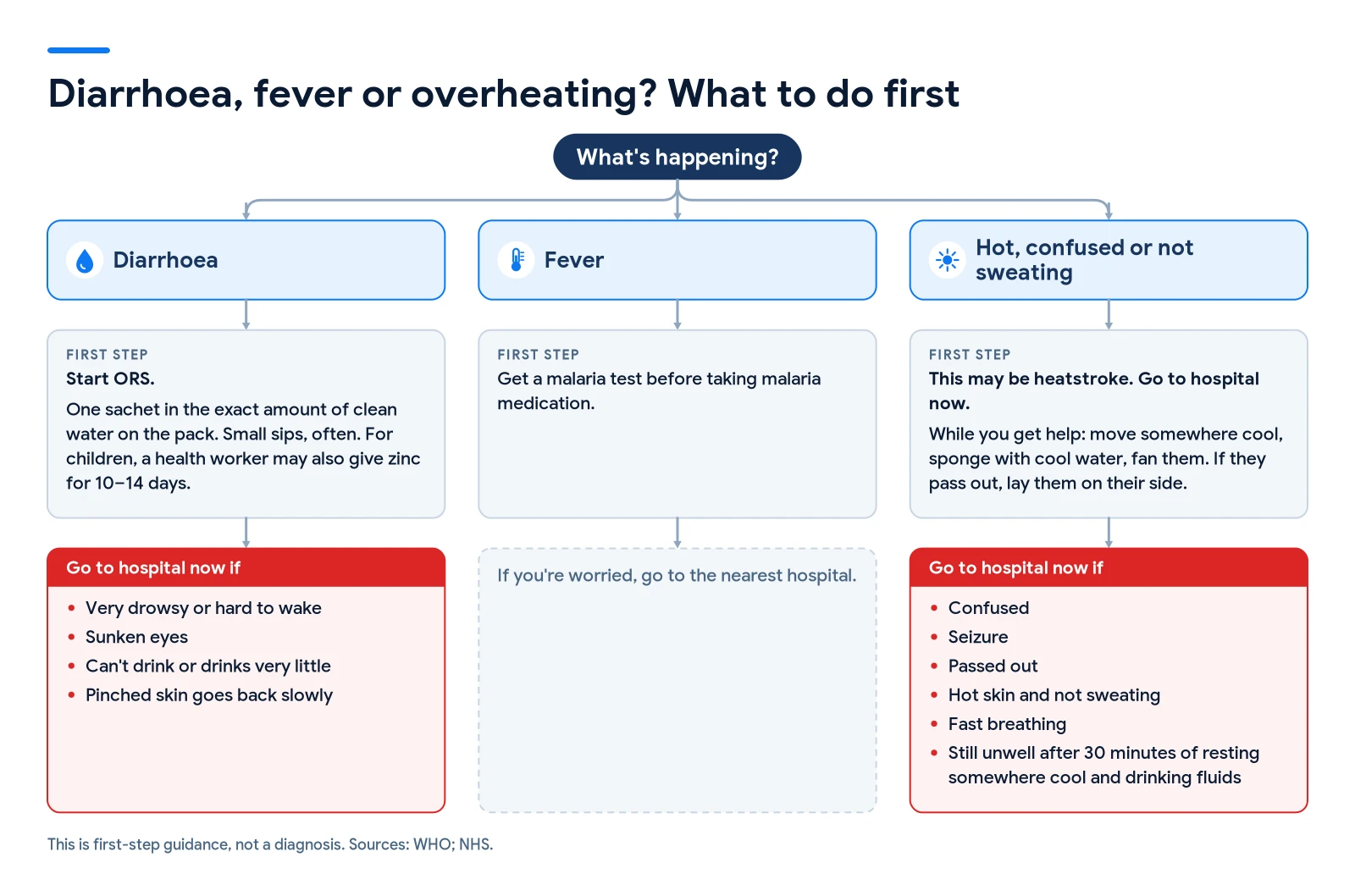
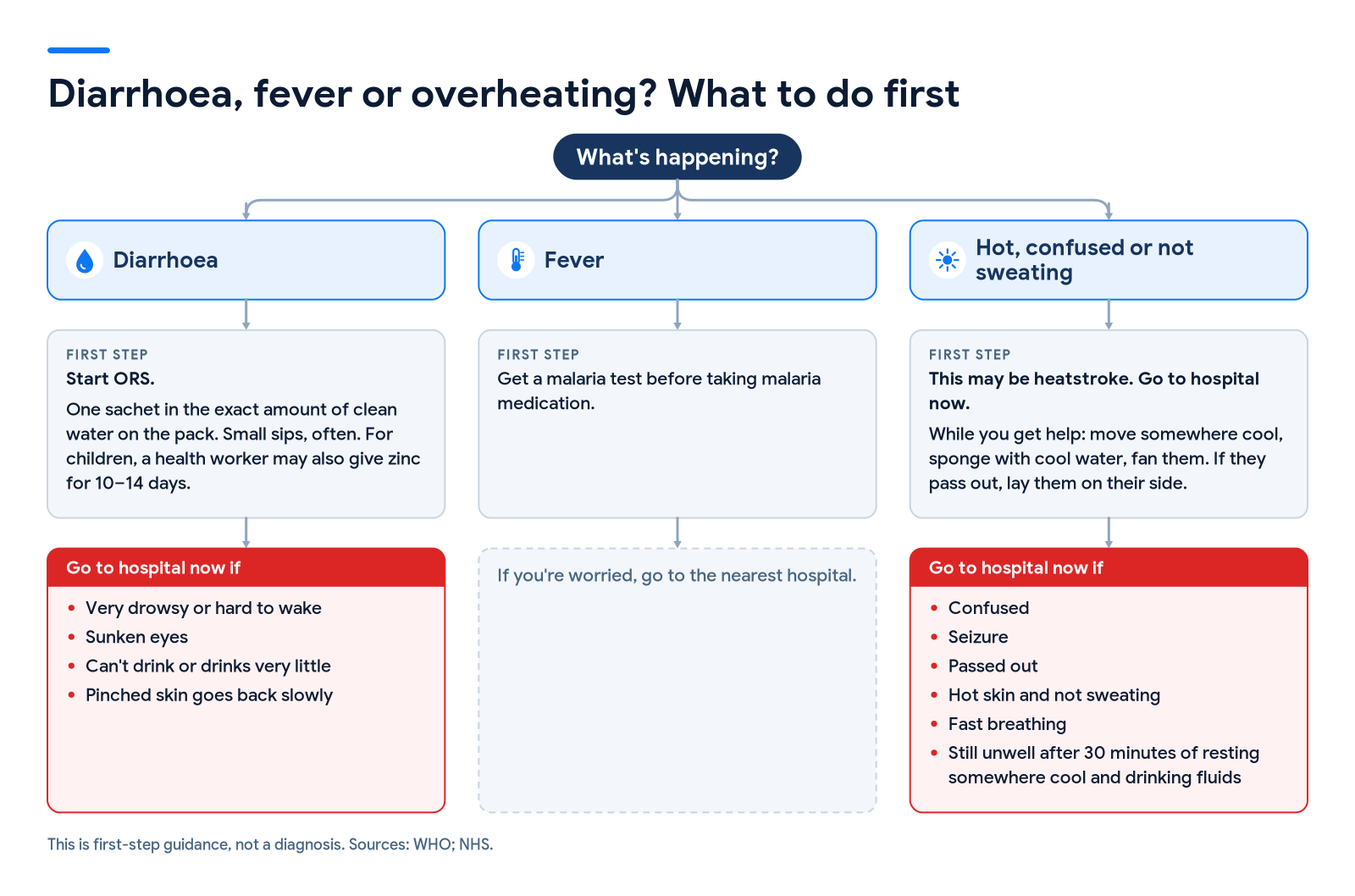
Start ORS straight away for diarrhoea, and get a malaria test before taking malaria medication for a fever. Someone who is hot, confused or not sweating may have heatstroke, so take them to the nearest hospital now.
Hot weather and erratic rain can bring more diarrhoea and fever. Here's what to do in the first few hours.
| Situation | What to watch for | What to do |
|---|---|---|
| Go to hospital now | Confusion, a seizure, passing out, hot skin with no sweating, fast breathing or not being able to drink. With diarrhoea: very drowsy, sunken eyes, drinking very little, or pinched skin that goes back slowly. Still unwell after 30 minutes of resting somewhere cool and drinking fluids | Take them to the nearest hospital now. While you get help, move them somewhere cool, sponge them with cool water and fan them. If they pass out, lay them on their side |
| See a doctor or pharmacist today | A fever. Early signs of dehydration such as dizziness, headaches, tiredness or dark urine | Get a malaria test at a lab or clinic before taking malaria medication. For signs of dehydration, drink water or ORS, move somewhere cool and speak to a pharmacist |
| Treat at home and watch | Diarrhoea without any of the signs above | Start ORS straight away: one sachet in the exact amount of clean water on the pack, in small sips often. Watch for the hospital signs above |
Diarrhoea
Start oral rehydration salts (ORS) straight away. Mix one sachet with the exact amount of clean water on the pack, and give small sips often. For children, a health worker may also recommend zinc for 10 to 14 days.
Go to a hospital if the person is very drowsy, has sunken eyes, can't drink or drinks very little, or if pinched skin goes back slowly.
Fever
Get a malaria test before taking malaria medication. WHO advises treating confirmed cases, because not every fever is malaria, and a quick test at a lab or clinic tells you what you're treating.
If you've been sleeping outside or without a net, mention it when you get tested.
Hot, confused or not sweating
This can be heatstroke, and it's an emergency. Take the person to the nearest hospital now. While you get help, move them somewhere cool, sponge them with cool water and fan them. If they pass out, lay them on their side.
Go to hospital now if: someone is confused, has a seizure, has passed out, has hot skin and isn't sweating, has fast breathing, can't drink, or is still unwell after 30 minutes of resting somewhere cool and drinking fluids.
Before tonight:
- Keep 2 or 3 ORS sachets at home.
- Put water by your bed and set a phone alarm for your usual night-time dose.
- Hang a mosquito net wherever you sleep, including outside.
Common questions about hot nights and heat rash
What helps heat rash?
Can heat rash turn into an infection?
Is it safe to sleep outside when it is this hot?
Once you have a plan for tonight, check the medication you take each day and count how many days remain in each pack. The next guide covers medications that need extra attention in heat, early refills and caring for a parent in another city. Read the guide to daily medication, refills and caregiving, or return to the main guide to medication storage and power cuts.
If you can answer these, the article did its job.
References
Sources checked on 29 October 2026.
- World Health Organization. Diarrhoeal disease fact sheet. https://www.who.int/news-room/fact-sheets/detail/diarrhoeal-disease
- World Health Organization. Malaria fact sheet. https://www.who.int/news-room/fact-sheets/detail/malaria
- NHS. Heat exhaustion and heatstroke. https://www.nhs.uk/conditions/heat-exhaustion-heatstroke/
- NHS. Heat rash (prickly heat). https://www.nhs.uk/conditions/heat-rash-prickly-heat/
- NHS. Heatwave: how to cope in hot weather. https://www.nhs.uk/live-well/seasonal-health/heatwave-how-to-cope-in-hot-weather/
- Healthdirect Australia. Heat rash: causes, treatment and when to get care. https://www.healthdirect.gov.au/symptoms/heat-rash
Posts embedded from X
- @____jola, 29 Oct 2026: https://x.com/____jola/status/2115643167349346615
- @lusciousgemm, 26 Oct 2026: https://x.com/lusciousgemm/status/2114721064366284981
Icons by Magnific from www.flaticon.com.